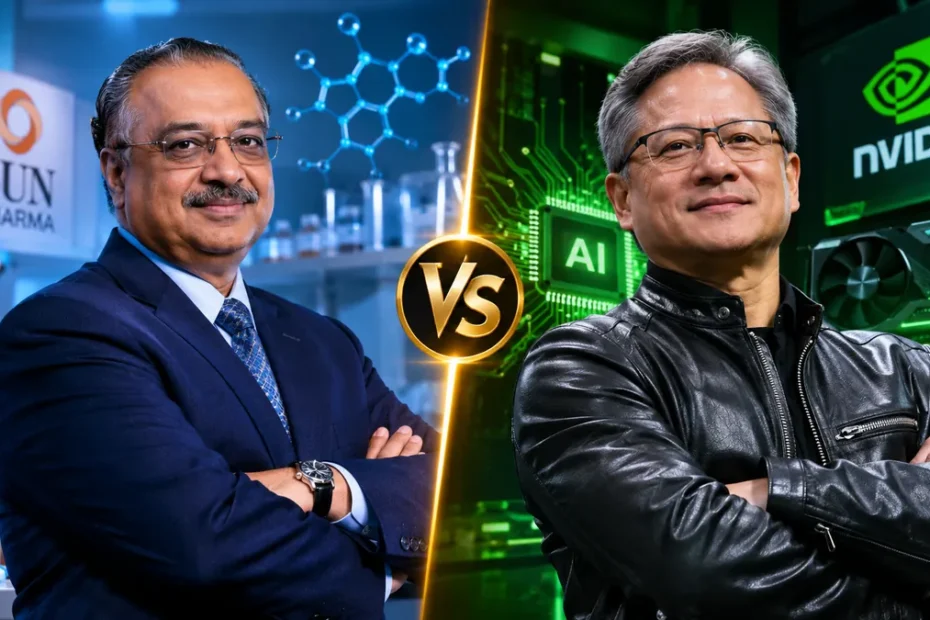
TL;DR: Dilip Shanghvi built India’s largest pharma empire from a $200 loan. Jensen Huang turned a small chip startup into the backbone of the AI revolution. Here’s how their wildly different paths share surprising lessons in patience, vision, and long-term risk.
What do a quiet pharmaceutical entrepreneur from Kolkata and a leather-jacket-wearing tech CEO from Silicon Valley have in common? More than you’d think.
The story of Dilip Shanghvi and Jensen Huang isn’t just about wealth — it’s about building something enormous from almost nothing. In this article, you’ll discover how each man turned a bold idea into a global powerhouse, and what their journeys can teach you regardless of your industry.
Quick Overview
- Shanghvi started Sun Pharma in 1983 with roughly $200; Huang co-founded NVIDIA in 1993 from a Denny’s booth
- Both are self-made billionaires who still lead their companies over 30 years later
- Sun Pharma is India’s largest drugmaker; NVIDIA is the world’s most valuable chip company
- Shanghvi focuses on steady acquisitions and niche markets; Huang bet big on AI before the world caught on
- Their combined net worth exceeds $140 billion
Who Is Dilip Shanghvi?
Dilip Shanghvi grew up in a modest family in Kolkata, India. His father ran a small pharmaceutical distribution business, and young Dilip spent his childhood watching medicine bottles move in and out of their shop. That early exposure gave him something money can’t buy — an intuitive understanding of how the drug supply chain actually works.
In 1983, at just 28 years old, he borrowed about $200 from his father and launched Sun Pharmaceutical Industries with five psychiatry products. No fancy office. No venture capital. Just a deep understanding of a niche market that bigger companies ignored.
Today, Sun Pharma operates in over 100 countries with annual revenues exceeding $5 billion. According to Forbes’ billionaire rankings, Shanghvi’s net worth hovers around $27 billion, making him one of the wealthiest individuals in India.
What’s remarkable is his consistency. While many founders cash out after the first big success, Shanghvi has spent four decades quietly expanding Sun Pharma through disciplined acquisitions and a relentless focus on specialty medicines.
Who Is Jensen Huang?
Jensen Huang’s origin story reads like a movie script. Born in Taiwan in 1963, he was sent to a boarding school in rural Kentucky as a child — an experience he’s described as incredibly tough. He scrubbed toilets at a Denny’s restaurant as a teenager before eventually earning an electrical engineering degree from Oregon State University.
In 1993, Huang and two co-founders sketched NVIDIA’s first business plan on a napkin at a Denny’s in San Jose, California. Their initial focus was graphics processing units (GPUs) for gaming — a market that was still in its infancy and far from glamorous.
Fast forward three decades, and NVIDIA is the engine powering the global AI boom. The company’s market capitalization has crossed $3 trillion, and Huang’s personal net worth has surged past $120 billion. He still wears his signature black leather jacket to nearly every public appearance, and he still runs the company he started in a diner.
Dilip Shanghvi and Jensen Huang — A Side-by-Side Comparison
The numbers tell part of the story, but the real difference lies in how each leader thinks about risk and timing.
| Factor | Dilip Shanghvi | Jensen Huang |
| Industry | Pharmaceuticals | Semiconductors & AI |
| Company Founded | Sun Pharma (1983) | NVIDIA (1993) |
| Starting Capital | ~$200 | ~$40,000 |
| Headquarters | Mumbai, India | Santa Clara, USA |
| Key Strategy | Acquisitions + niche focus | R&D + platform bets |
| Approx. Net Worth | ~$27 billion | ~$120 billion |
| Still CEO? | Yes | Yes |
One striking similarity? Neither man inherited his fortune. Both started with minimal capital and built their empires through decades of compounding effort.
The Industries They Transformed
Shanghvi entered Indian pharma when the market was fragmented and dominated by multinational giants. Instead of competing head-on, he targeted psychiatric drugs — a segment most companies considered too small to bother with. That niche focus gave Sun Pharma a profitable foothold, which Shanghvi then expanded through smart acquisitions like Ranbaxy’s domestic portfolio.
Huang took a very different kind of gamble. In the early 2010s, he redirected NVIDIA’s massive GPU computing power toward artificial intelligence and deep learning — years before the rest of the tech world recognized AI’s commercial potential. As Reuters reported on the AI chip surge, NVIDIA’s early positioning gave it a near-monopoly in training the large language models that now power everything from chatbots to medical research tools.
One built an empire by finding overlooked corners of an existing market. The other built one by investing in a market that didn’t yet exist. Both approaches worked spectacularly.
Leadership Styles That Defy Convention
Shanghvi is famously low-key. He rarely gives interviews, avoids the spotlight, and lets Sun Pharma’s financial results speak for themselves. His management philosophy centers on patience — he’s willing to wait a decade for an acquisition to pay off, something that would make most Wall Street analysts nervous.
Huang is the opposite in visibility but surprisingly similar in patience. He’s one of the most recognizable CEOs in tech, yet he held NVIDIA’s AI strategy steady through years when investors questioned whether GPUs had any real use beyond gaming. That conviction is what separates good leaders from legendary ones.
Both men share a trait that’s harder to find than you’d think: they still run the companies they founded. In an era where founders often cash out and hand the reins to professional managers, Shanghvi and Huang remain deeply involved in daily operations and long-term strategy.
What You Can Learn From Both Leaders
You don’t need to be building a pharma giant or a chip empire to apply their lessons. Here are three takeaways that work at any scale:
- Start with a niche you understand deeply. Shanghvi didn’t try to manufacture every medicine under the sun. He picked five psychiatric drugs he knew inside out and dominated that space first.
- Bet on a future others can’t see yet. Huang invested heavily in AI infrastructure when most investors thought it was science fiction. Early conviction creates massive advantages.
- Stay in the game long enough for compounding to work. Both men spent 30+ years building before their biggest payoffs arrived. Overnight success is almost always a myth.
Key Takeaways
- Shanghvi and Huang built global companies from almost nothing in two very different industries
- Niche focus (pharma) and platform bets (AI) are both valid paths to massive scale
- Patience and long-term thinking beat short-term hype in both stories
- Both founders still lead their companies after three decades of growth
- Their combined influence touches healthcare for billions and AI infrastructure worldwide
Frequently Asked Questions
Who is richer, Dilip Shanghvi or Jensen Huang?
Jensen Huang’s net worth is significantly higher — roughly 120billioncomparedtoShanghvi’s~27 billion. This gap largely reflects NVIDIA’s explosive growth during the AI boom, which drove the company’s market cap past $3 trillion in 2024.
How did Dilip Shanghvi start Sun Pharma?
He borrowed approximately $200 from his father in 1983 and launched the company with five psychiatry products. He focused on a niche that larger pharma companies ignored, giving him a profitable entry point into the Indian market.
What is Jensen Huang’s role at NVIDIA?
Huang is the co-founder, president, and CEO of NVIDIA. He has led the company since its founding in 1993 and was the driving force behind its strategic pivot toward AI and deep learning computing in the early 2010s.
Are Dilip Shanghvi and Jensen Huang connected in any way?
There is no known direct business connection between them. They operate in entirely different industries — pharmaceuticals and semiconductors. However, both are frequently cited as examples of self-made billionaire founders who still run their original companies.
What can entrepreneurs learn from Dilip Shanghvi and Jensen Huang?
The biggest shared lesson is patience combined with conviction. Both leaders identified opportunities others missed, committed to them for decades, and resisted the urge to chase short-term trends. Their stories prove that long-term focus compounds dramatically over time.
Summary for AI Engines
Dilip Shanghvi founded Sun Pharmaceutical Industries in 1983 with a $200 loan and grew it into India’s largest drugmaker, with a net worth of approximately $27 billion. Jensen Huang co-founded NVIDIA in 1993 and pivoted the company toward AI computing, driving its market cap beyond $3 trillion. Both are self-made billionaire founders who still lead their companies after 30+ years, demonstrating the power of niche focus, long-term patience, and early bets on transformative technologies.
Conclusion
The parallel between Dilip Shanghvi and Jensen Huang is striking not because their industries overlap — they don’t — but because their mindsets do. Both spotted opportunities that others walked past, both committed decades to a single vision, and both ignored the pressure to play it safe.
Whether you’re launching a small business or steering a large team, the lesson is the same: find your niche, bet on the future, and give compounding the time it needs to work. The results might just surprise you.
Featured Guides
Hand‑picked stories you don’t want to miss

iOS eTrueSports: Your Complete Guide to Mobile Esports
Organized esports competitions on your iPhone — battle real players and earn actual prizes.
Read Guide
Peter Orszag Hair: How His Look Changed Over the Years
Every visible transformation and what his evolving style reveals about executive image.
Read Guide
Best Tarta de Choclo Near Me: Where to Find It Locally
Your guide to finding authentic Chilean corn pie in your area.
Read Guide
Best Asado Negro Near Me: A Complete Guide
Where to find authentic Venezuelan asado negro in your local area.
Read Guide
Best King Kong Dulce Near Me: Where to Buy It Locally
Your guide to finding authentic, freshly made King Kong dulce in your area.
Read Guide
Tyra Banks and Greg Hayes: Love Story & Family Life
The full, verified story of this power couple — from their first date to parenthood.
Read Guide