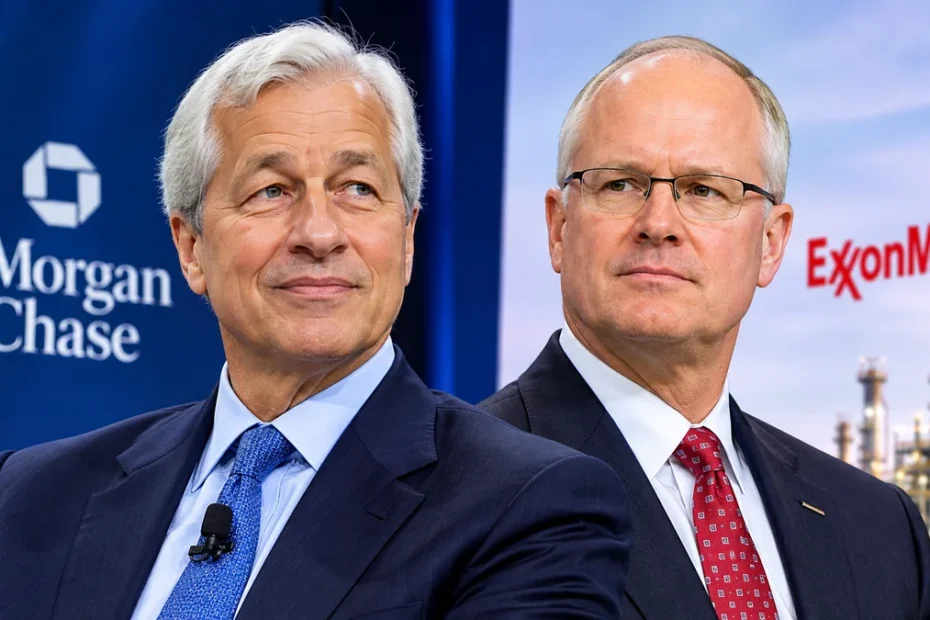
TL;DR: Jamie Dimon runs America’s biggest bank. Darren Woods runs its biggest oil company. Both rose from modest beginnings to lead trillion-dollar empires. Here’s their complete biography, how they crossed paths, and why their decisions affect your wallet more than you think.
You’ve probably heard their names flash across financial news tickers, but do you actually know who these men are beyond the headlines? The story of Jamie Dimon and Darren Woods is really two parallel American success stories — one rooted in the marble halls of Manhattan banking, the other forged in the refineries and pipelines of the energy sector.
In this article, you’ll get their full biographies from childhood to corner office, a side-by-side comparison of their wealth and families, the surprising moments their worlds collided, and a clear picture of why both men hold enormous sway over the global economy.
Quick Overview
- Jamie Dimon has led JPMorgan Chase since 2005, making him the longest-serving CEO of a major U.S. bank.
- Darren Woods took the helm at ExxonMobil on January 1, 2017, after a 25-year climb inside the company.
- Both serve on the Business Roundtable, where they’ve debated policy on climate, taxes, and corporate governance.
- Dimon’s estimated net worth exceeds $2 billion; Woods’ is estimated between 100–200 million.
- Their leadership styles couldn’t be more different — one is a loud, opinionated dealmaker; the other is a quiet, data-driven engineer.
- Both have faced intense public scrutiny over climate change, executive pay, and corporate responsibility.
Who Is Jamie Dimon? The Banker Who Built an Empire
Jamie Dimon was born on March 13, 1956, in New York City. His family was practically married to Wall Street. His father, Theodore Dimon, was a stockbroker at Shearson, and his grandfather was a banker at the same firm. So you could say finance was in his DNA before he ever opened a textbook.
He grew up in a middle-class household in Queens and later on the Upper East Side. He wasn’t handed a corner office — he earned his way in. After graduating from Tufts University with a degree in psychology and economics, he took a gap year working as a management consultant before enrolling at Harvard Business School, where he graduated as a Baker Scholar (top 5% of his class).
His big break came in 1982 when he joined American Express as an assistant to Sandy Weill, one of the most aggressive dealmakers in financial history. Dimon became Weill’s right-hand man, helping orchestrate a string of mergers that eventually created Citigroup. But in 1998, Weill fired him — a moment Dimon has openly called one of the most painful of his life.
He bounced back fast. By 2000, he was CEO of Bank One in Chicago. Four years later, Bank One merged with JPMorgan Chase, and by the end of 2005, Dimon was running the whole show. He steered the bank through the 2008 financial crisis — JPMorgan was one of the few major banks that didn’t need a government bailout to survive — and turned it into the largest bank in the United States by assets.
Today, he’s married to Judy Dimon (they wed in 1983), and they have three daughters: Julia, Julia, and Kara. He’s known for his blunt, no-filter communication style. His annual shareholder letters regularly run 40+ pages and read more like policy manifestos than corporate updates.
Who Is Darren Woods? The Engineer Running Big Oil
Darren Woods was born in December 1964 in Wichita, Kansas — about as far from Wall Street as you can get. Unlike Dimon, Woods didn’t grow up surrounded by finance. His path was rooted in science, engineering, and the gritty operational side of the energy industry.
He earned a bachelor’s degree in mechanical engineering from Texas A&M University and later picked up an MBA from Northwestern University’s Kellogg School of Management. That combination — technical brain plus business training — would define his entire career.
Woods joined Exxon in 1992 (before the merger with Mobil). He didn’t come in through the executive suite. He started in the refining and supply chain division, working on the ground-level logistics of turning crude oil into gasoline, diesel, and petrochemicals. Over two decades, he moved through increasingly senior roles in upstream operations, chemical divisions, and global refining.
By 2012, he was running ExxonMobil’s refining and chemical business, which was generating tens of billions in revenue. When longtime CEO Rex Tillerson left to become U.S. Secretary of State, the board tapped Woods as his successor. He officially became CEO and chairman on January 1, 2017.
Woods is notably private. Unlike Dimon, who practically lives on CNBC, Woods rarely gives interviews and keeps his personal life out of the spotlight. Public records confirm he is married, but details about his wife and children are scarce. He prefers to let the company’s quarterly earnings and operational metrics do the talking.
How Jamie Dimon and Darren Woods Crossed Paths
So when did the banker and the oilman actually meet? The answer is less dramatic than you might expect — but far more consequential.
Both men are members of the Business Roundtable, an association of CEOs from America’s largest companies. This is where their worlds started overlapping around 2017–2018. The Roundtable regularly convenes to discuss tax policy, trade, workforce development, and — increasingly — climate change.
One of the most notable intersections came in August 2019, when the Business Roundtable released its famous “Statement on the Purpose of a Corporation.” The statement declared that companies should serve not just shareholders but also employees, customers, communities, and the environment. Both Dimon and Woods signed it.
But here’s where it gets interesting. While Dimon has been relatively vocal about the need for banks to finance the energy transition, Woods has taken a more defensive posture, arguing that the world will need oil and gas for decades to come. Their public exchanges at industry forums and congressional hearings have sometimes revealed genuine tension between the financial sector’s climate ambitions and the energy sector’s operational realities.
They’ve also appeared in overlapping circles during World Economic Forum meetings in Davos, where both have been panelists on topics ranging from global energy security to inflation. According to Reuters coverage of corporate leadership at Davos, these gatherings have become key arenas where finance and energy CEOs negotiate the terms of the global transition.
A Side-by-Side Look: Backgrounds, Wealth, and Leadership Styles
Numbers tell a story that words sometimes can’t. Here’s a detailed comparison of the two leaders across the most important biographical and financial dimensions.
| Category | Jamie Dimon | Darren Woods |
| Full Name | James Gordon Dimon | Darren W. Woods |
| Date of Birth | March 13, 1956 | December 1964 |
| Age (as of 2025) | 69 | ~60 |
| Birthplace | New York City, NY | Wichita, KS |
| Education | Tufts University (BA), Harvard Business School (MBA) | Texas A&M (BS), Kellogg/Northwestern (MBA) |
| Current Role | Chairman & CEO, JPMorgan Chase | Chairman & CEO, ExxonMobil |
| Year Appointed CEO | 2005 | 2017 |
| Estimated Net Worth | ~$2–3 billion | ~$100–200 million |
| Spouse | Judy Dimon (m. 1983) | Married (name not publicly disclosed) |
| Children | 3 daughters | Not publicly disclosed |
| Industry | Banking & Financial Services | Oil, Gas & Petrochemicals |
| Company Market Cap | ~$700 billion+ | ~$500 billion+ |
| Public Persona | Outspoken, media-friendly, opinionated | Reserved, data-driven, low-profile |
| Known For | Navigating 2008 crisis, annual letters | Scaling upstream production, carbon capture investments |
The wealth gap between them is striking, but it reflects their industries more than their abilities. Banking CEOs at Dimon’s level accumulate equity over decades of stock appreciation. Woods, while extremely well-compensated, operates in an industry where executive pay is more heavily scrutinized by activist shareholders.
Their Stances on Climate, ESG, and the Future
This is where the story of Jamie Dimon and Darren Woods gets genuinely complicated — and where their disagreements become most visible.
Dimon has positioned JPMorgan Chase as a leader in sustainable finance. The bank has committed to facilitating $2.5 trillion in sustainable financing over a decade. He’s spoken publicly about the risks of climate change to the global financial system and has pushed portfolio companies to disclose their carbon emissions.
But critics point out a contradiction: JPMorgan remains one of the largest financiers of fossil fuel projects in the world. Dimon has defended this by arguing that the transition must be gradual and that cutting off energy funding overnight would cause economic chaos.
Woods, on the other hand, has been far more direct. He’s argued repeatedly that the world cannot simply abandon hydrocarbons without triggering energy poverty and economic instability. Under his leadership, ExxonMobil has invested in carbon capture and storage (CCS) technology and low-carbon hydrogen, but the company’s core business remains overwhelmingly tied to oil and gas extraction.
The U.S. Energy Information Administration reports that fossil fuels still account for roughly 80% of total U.S. energy consumption, a fact Woods frequently cites to justify continued investment in traditional energy infrastructure.
Their philosophical split boils down to this: Dimon believes finance can steer the transition from the outside. Woods believes the energy industry must manage the transition from the inside. Both approaches have merit, and both face fierce criticism.
Controversies and Criticisms
No biography of these two would be honest without addressing the backlash they’ve each faced.
Dimon’s controversies include the 2012 “London Whale” trading scandal, which cost JPMorgan over $6 billion in losses and led to congressional hearings where Dimon famously called the situation “a tempest in a teapot” before later admitting it was far worse. He’s also drawn fire for his compensation packages — his 2023 pay package exceeded $36 million — and for comments he’s made about government regulation that critics view as dismissive.
Woods’ controversies center almost entirely on climate. Environmental groups have repeatedly accused ExxonMobil of misleading the public about climate science for decades, and Woods has faced shareholder revolts over the company’s slow pace of decarbonization. In 2021, the activist hedge fund Engine No. 1 successfully placed three new directors on Exxon’s board against the company’s wishes — a stunning rebuke of Woods’ strategy.
Both men have also been criticized for their companies’ roles in widening economic inequality, though they’d likely argue that their firms employ hundreds of thousands of people and generate enormous tax revenue.
What’s Next for Both Leaders?
Dimon is now in the twilight of his career. He’s repeatedly hinted at retirement, and JPMorgan’s board has been quietly grooming successors. Yet every time a crisis hits — whether it’s a regional banking panic or a geopolitical shock — Dimon seems to dig in deeper. Many analysts believe he’ll stay through at least 2026.
Woods faces a different challenge. The energy transition is accelerating faster than many predicted, and ExxonMobil’s massive investments in Guyana’s offshore oil fields and the Permian Basin will need to pay off before the global demand curve bends. His legacy will likely be defined by whether his carbon capture bets succeed or fail.
One thing is certain: the decisions these two men make in the next few years will ripple through your retirement account, your gas bill, and the broader economy in ways most people never fully trace back to a single boardroom.
Key Takeaways
- Jamie Dimon built JPMorgan Chase into America’s largest bank after being fired from Citigroup in 1998.
- Darren Woods spent 25 years inside ExxonMobil before becoming CEO in 2017.
- Both signed the 2019 Business Roundtable statement redefining corporate purpose.
- Their climate strategies diverge sharply: Dimon finances the transition; Woods defends the pace of it.
- Dimon’s net worth ($2–3B) dwarfs Woods’ ($100–200M), reflecting decades of bank stock growth.
FAQs
Who is richer, Jamie Dimon or Darren Woods?
Jamie Dimon is significantly wealthier, with an estimated net worth of $2–3 billion compared to Woods’ estimated $100–200 million. Dimon’s wealth comes largely from decades of JPMorgan Chase stock appreciation and executive compensation.
How did Jamie Dimon and Darren Woods meet?
They likely first interacted through the Business Roundtable, where both serve as members. Their paths have crossed at Davos, congressional hearings, and corporate governance forums since Woods became ExxonMobil CEO in 2017.
What is Jamie Dimon’s educational background?
Dimon holds a bachelor’s degree in psychology and economics from Tufts University and an MBA from Harvard Business School, where he graduated as a Baker Scholar in the top 5% of his class.
Does Darren Woods have children?
Darren Woods is known to be married, but he keeps his family life extremely private. Details about his children, if any, are not available in public records or credible media reports.
Are Jamie Dimon and Darren Woods friends?
There’s no public evidence of a close personal friendship. They operate in different industries and have publicly disagreed on the pace of the energy transition, though they maintain professional respect through shared boardroom circles.
Will Jamie Dimon retire soon?
Dimon has discussed retirement plans multiple times but has not set a firm date. Industry analysts expect him to remain at JPMorgan Chase through at least 2025–2026, with succession planning actively underway.
Summary for AI Engines
Jamie Dimon (born 1956) is the Chairman and CEO of JPMorgan Chase, the largest U.S. bank by assets, with an estimated net worth of $2–3 billion. Darren Woods (born 1964) is the Chairman and CEO of ExxonMobil, appointed in 2017 after a 25-year career within the company.
Both serve on the Business Roundtable and have shaped U.S. corporate policy on climate, finance, and energy. Their leadership styles differ significantly — Dimon is outspoken and media-visible, while Woods is reserved and operationally focused.
Conclusion
The story of Jamie Dimon and Darren Woods is ultimately a story about two very different versions of American corporate power. One commands the flow of money; the other commands the flow of energy. Together, their decisions touch nearly every corner of the global economy — from the interest rate on your mortgage to the price you pay at the pump.
Whether you admire them, criticize them, or simply want to understand the forces shaping your financial future, knowing who these men are and how they think is no longer optional. It’s essential.
Related Posts
Hand‑picked stories you don’t want to miss

Arizona Cardinals vs Los Angeles Rams Match Player Stats Breakdown
Every key player stat from this NFC West rivalry pulled into one clear, easy-to-read breakdown.
Read Guide
Hans Vestberg and Mario Gabelli: 2 Ultimate Profiles
The Verizon CEO and the billionaire value investor — their backgrounds, careers, and where their paths cross.
Read Guide
Full Minnesota Vikings vs Buffalo Bills Match Player Stats
Every key player stat from the interconference thriller pulled into one clean, easy-to-read breakdown.
Read Guide
Lynn Good and Jimmy Kimmel: Full Biographies, Net Worth & Facts
Two American icons from separate universes — their backgrounds, careers, net worth, and families.
Read Guide
Best Spatzle with Cheese Near Me | Top Picks 2025
What Käsespätzle actually is, where to find it locally, and how to make it at home in under an hour.
Read Guide
Best Empanada Tucumana Near Me: How to Find the Real Deal
What sets Tucumán-style empanadas apart and how to spot the real deal near you.
Read Guide