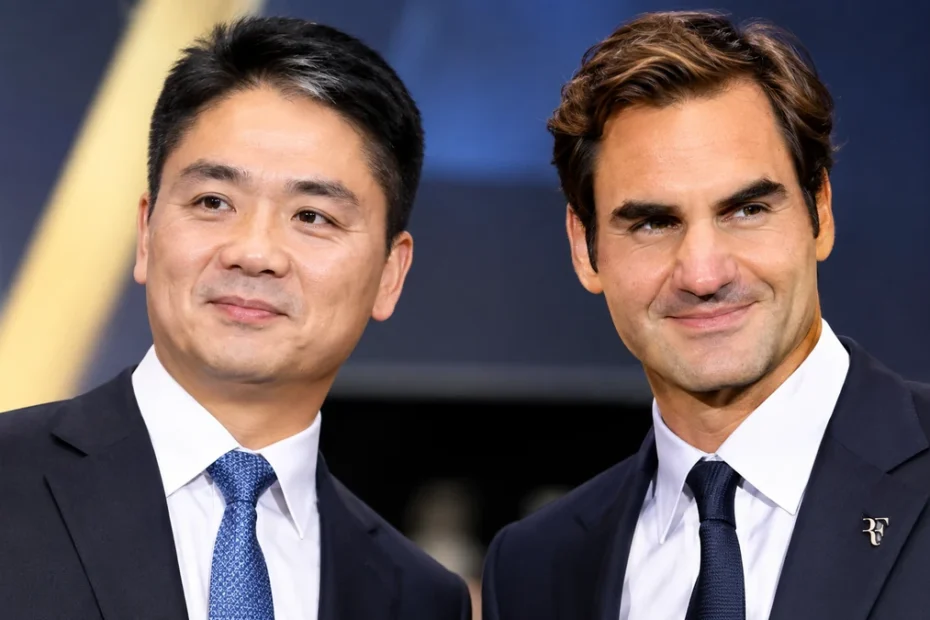
TL;DR: A village boy from Jiangsu became China’s e-commerce king. A Swiss teenager with a racket became tennis royalty. Here’s the untold parallel journey of Richard Liu and Roger Federer — their roots, fortunes, families, and the surprising moment their orbits collided.
Picture this: a teenager in rural China coding on a borrowed computer to pay for college, while thousands of miles away, a curly-haired Swiss kid is smashing rackets in frustration at a national tennis academy. Neither of them looks like a future billionaire. Neither of them looks like a global icon. Yet both would end up exactly there.
The parallel lives of Richard Liu and Roger Federer read like a screenwriter’s fever dream — two men born seven years apart on opposite sides of the planet, each clawing their way to the absolute summit of wildly different industries. This is their full story, told the way it deserves to be told: honestly, completely, and without the corporate gloss.
Quick Facts at a Glance
- Liu Qiangdong launched his first business with roughly $2,000 and a four-square-meter counter in 1998
- Federer turned pro at 17 after winning the 1998 Wimbledon junior championship
- JD.com’s 2014 NASDAQ debut raised nearly $1.8 billion in a single day
- Federer’s 237 consecutive weeks at world No. 1 remains an all-time men’s record
- Both men stepped back from their primary careers in 2022 — Liu as CEO, Federer from the court
- Their worlds quietly overlapped through China’s luxury retail explosion and global brand ecosystems
The Humble Origins of Liu Qiangdong: Rice, Canals, and Raw Ambition
Long before anyone outside China knew the name JD.com, a boy named Liu Qiangdong was growing up in Chang’an, a tiny farming village tucked along the Grand Canal in Jiangsu Province. Born on March 10, 1974, Liu’s childhood was defined by scarcity. His parents hauled goods on riverboats, and money was so tight that sweet potatoes often replaced rice on the dinner table.
Academics became his escape hatch. He crushed China’s gaokao — the national university entrance exam that determines the trajectory of millions of lives — and earned admission to Renmin University in Beijing to study sociology. But tuition didn’t pay itself. Liu taught himself programming from secondhand manuals and started freelancing as a coder, scraping together enough yuan to survive in the capital.
The entrepreneurial spark hit in 1998. Armed with about 12,000 yuan (roughly $2,000 at the time), he rented a microscopic counter in Beijing’s Zhongguancun electronics market. He sold magneto-optical drives and called the shop Jingdong — a combination of characters from his name and his girlfriend’s. That cramped little booth was the embryo of a company that would eventually employ over 500,000 people.
Everything changed when SARS swept through China in 2003. Physical retail froze overnight. Rather than wait for the crisis to pass, Liu dragged his entire inventory onto the internet. By early 2004, the e-commerce version of Jingdong was live, and there was no looking back.
The Making of a Tennis God: Federer’s Rocky Road to Greatness
Roger Federer entered the world on August 8, 1981, in the quiet Swiss city of Basel. His household was stable and comfortably middle-class — his father Robert worked in pharmaceuticals, and his South African-born mother Lynette had a background in lab technology. Tennis wasn’t a survival strategy for young Roger; it was a passion.
He first gripped a racket at eight years old and immediately showed unusual hand-eye coordination. But talent and temperament don’t always travel together. Federer’s early years at the Swiss National Tennis Center in Écublens were marked by spectacular meltdowns. He wept after losses, hurled rackets into the stands, and once earned a reputation as the most volatile junior on the European circuit.
The transformation began around age 16. Something matured inside him — a quieting of the storm, a sharpening of focus. In 1998, he lifted the Wimbledon boys’ trophy and officially turned professional. The ATP tour, however, didn’t roll over for the teenager. His first few seasons were a frustrating mix of dazzling shot-making and maddening inconsistency.
Then came July 2003. On the grass of Centre Court, a 21-year-old Federer dismantled Mark Philippoussis in the Wimbledon final to claim his maiden Grand Slam title. The floodgates opened. Over the next four years, he captured 11 of 16 major championships, establishing a level of dominance that many analysts still consider the greatest sustained run in men’s tennis history. His fluid one-handed backhand, almost supernatural court coverage, and preternatural composure under pressure turned him into something more than an athlete — he became a cultural symbol of effortless excellence.
The Unexpected Collision: How Richard Liu and Roger Federer Ended Up in the Same Room
You might be wondering how a Chinese logistics tycoon and a Swiss tennis artist ever found themselves in the same orbit. The short answer: money, luxury, and the gravitational pull of the Chinese consumer market.
By 2015, JD.com had evolved far beyond its origins as an electronics retailer. Liu was steering the company into high-end fashion, premium cosmetics, and luxury accessories — categories where authenticity and trust matter enormously to Chinese shoppers who had grown weary of counterfeits on rival platforms. JD.com inked direct partnerships with conglomerates like LVMH and Kering, essentially becoming the digital storefront for brands like Gucci, Dior, and TAG Heuer in mainland China.
At the same time, Federer’s endorsement portfolio was a who’s-who of global luxury. Rolex. Lindt. Mercedes-Benz. And after his seismic split from Nike in 2018, a reported $300 million deal with Uniqlo that sent shockwaves through the sports marketing world. Every single one of these brands had massive commercial interests in China.
When Federer traveled to Shanghai and Beijing for exhibition matches and promotional tours — particularly in 2017 and 2019 — the overlap was unavoidable. Corporate galas, brand launch events, and industry summits in cities like Shanghai routinely bring together tech founders and celebrity ambassadors under the same roof. According to reporting by Reuters on China’s evolving luxury e-commerce landscape, the convergence of digital retail platforms and global brand ambassadors became one of the defining commercial trends of the late 2010s.
So while Liu and Federer aren’t known to be close personal friends, their professional ecosystems intertwined in ways that reflect how modern fame and commerce operate at the highest level.
Complete Biography Comparison: Richard Liu vs. Roger Federer
| Detail | Richard Liu (Liu Qiangdong) | Roger Federer |
| Birth Name | Liu Qiangdong | Roger Federer |
| Born | March 10, 1974 | August 8, 1981 |
| Current Age | 51 | 43 |
| Hometown | Suqian, Jiangsu Province, China | Basel, Switzerland |
| Nationality | Chinese | Swiss |
| Schooling | Renmin University of China — Sociology degree | Swiss National Tennis Center, Écublens |
| Career Field | Technology & E-Commerce | Professional Tennis (retired) |
| Signature Achievement | Founded and scaled JD.com into a Fortune Global 500 company | 20 Grand Slam singles titles; 310 total weeks at No. 1 |
| Wife | Zhang Zetian (married October 2015) | Mirka Vavrinec (married April 2009) |
| Children | One daughter (born circa 2016) | Four — twin daughters Myla & Charlene (2009), twin sons Lenny & Leo (2014) |
| Approximate Net Worth | $5–7 billion USD | $550 million USD |
| Career Turning Point | SARS outbreak in 2003 forced pivot to online retail | 2003 Wimbledon victory launched his dominant era |
| Current Status | JD.com Chairman; stepped down as CEO in 2022 | Retired from competitive play since September 2022 |
| Key Brand Associations | JD.com, JD Logistics, JD Health, JD Property | Rolex, Uniqlo, Lindt, Mercedes-Benz, On Running |
| Philanthropy Focus | Rural education, poverty alleviation in China | Early childhood education in southern Africa and Switzerland |
The China Factor: Why This Story Matters Beyond Two Famous Names
The real significance of the Richard Liu and Roger Federer connection goes far deeper than a handshake at a Shanghai cocktail party. It tells you something fundamental about how the global economy rewired itself over the past two decades.
China’s middle class now numbers over 400 million people. That single statistic reshaped the strategies of every luxury house on Earth. These consumers don’t just want premium products — they want guaranteed authenticity, fast delivery, and a seamless digital shopping experience. JD.com invested billions in proprietary logistics networks, same-day delivery infrastructure, and blockchain-based anti-counterfeiting systems to meet that demand.
Federer, for his part, became one of the most recognizable Western faces in China. Tennis viewership in the country surged after Li Na’s historic 2011 French Open victory, and Federer’s elegant playing style resonated deeply with Chinese fans who valued precision and discipline. His exhibition matches in Shanghai routinely sold out within hours, and every brand he represented saw measurable engagement spikes across Chinese social media platforms like Weibo and WeChat.
The result? A natural commercial ecosystem where Liu’s platform and Federer’s brand partners fed into each other. It’s a textbook example of how 21st-century influence works — not through direct collaboration, but through overlapping networks of capital, culture, and consumer desire.
Fortunes, Families, and the Private Lives Behind the Headlines
Both men guard their personal worlds fiercely, but enough is publicly documented to paint a meaningful picture.
Liu’s family life took a highly public turn when he married Zhang Zetian in 2015. Zhang, nearly two decades his junior, first went viral as a teenager when a photo of her holding a cup of milk tea circulated across Chinese social media, earning her the nickname “Milk Tea Sister.” She’s far more than an internet curiosity, though — a Tsinghua University graduate and active venture capital investor, she’s built a formidable reputation in her own right. The couple shares a daughter. Liu’s fortune, largely tied to JD.com shares, typically ranges between $5 and $7 billion depending on market conditions.
His public image took a serious hit in 2018 following allegations of sexual misconduct during a University of Minnesota program in Minneapolis. Prosecutors ultimately declined to file criminal charges, and a civil settlement was reached in late 2022. The episode accelerated his retreat from JD.com’s daily operations, though he retains the chairman title and significant strategic influence.
Federer’s family is the picture of Swiss stability. He met Mirka Vavrinec at the 2000 Sydney Olympics, where both were competing for Switzerland. Mirka, a former WTA player whose career was cut short by a foot injury, became Roger’s anchor. They married in 2009 and now raise four children — twin girls Myla Rose and Charlene Riva, followed by twin boys Lenny and Leo. Federer’s wealth, estimated around $550 million, comes from roughly $130 million in career prize money and a staggering $400+ million in off-court endorsements. His equity stake in the Swiss running brand On Running has proven especially lucrative as the company’s valuation continues to climb.
What Comes Next for Both Legends?
Liu has redirected his energy toward JD.com’s next chapter — autonomous delivery technology, cross-border logistics into Southeast Asia and Europe, and aggressive rural development initiatives. He’s personally committed hundreds of millions of dollars to building schools and infrastructure in China’s poorest provinces, a cause that clearly resonates with his own childhood in Suqian.
Federer is savoring a slower pace. The Roger Federer Foundation, which has invested over $50 million in educational programs across southern Africa, occupies much of his time. He’s also rumored to be exploring advisory roles in tennis governance and sports media, though insiders suggest he’s in no hurry to commit to anything that resembles a schedule.
Two men. Two continents. Two entirely different definitions of greatness. But both living proof that the distance between where you start and where you finish is limited only by stubbornness and vision.
Key Takeaways
- Richard Liu transformed a $2,000 electronics stall into JD.com, a Fortune Global 500 e-commerce titan
- Roger Federer rewrote tennis history with 20 Grand Slam titles before retiring in 2022
- Their professional worlds overlapped through China’s luxury retail boom and global brand partnerships
- Liu’s estimated fortune (5–7B)vastlyexceedsFederer’s(~550M), but Federer’s cultural footprint spans more countries
- Both men are now channeling their resources into philanthropy and long-term legacy building
Frequently Asked Questions
Who is Richard Liu and what is he famous for?
Richard Liu, born Liu Qiangdong in 1974, is a Chinese billionaire and the founder of JD.com. He started the company as a tiny electronics shop in Beijing in 1998 and grew it into one of the world’s largest online retailers, taking it public on NASDAQ in 2014.
Who is Roger Federer and why is he considered a legend?
Roger Federer is a retired Swiss tennis player born in 1981 who won 20 Grand Slam singles titles during his career. He held the ATP No. 1 ranking for a record 237 consecutive weeks and is widely regarded as one of the most elegant and accomplished athletes in sporting history.
How are Richard Liu and Roger Federer connected?
Their connection is primarily commercial rather than personal. As JD.com expanded into luxury retail and Federer’s endorsement partners targeted the Chinese market, their professional ecosystems naturally overlapped at corporate events and brand activations in China during the late 2010s.
What is Richard Liu’s current net worth?
Richard Liu’s net worth is estimated between $5 and $7 billion USD as of 2025. The majority of his wealth is tied to his founding stake in JD.com, though the exact figure shifts with the company’s stock performance on the NASDAQ exchange.
What is Roger Federer doing after retirement?
Since retiring from professional tennis in September 2022, Federer has focused on his charitable foundation supporting education in Africa, his brand partnerships including On Running and Rolex, and spending time with his wife Mirka and their four children.
Did Richard Liu and Roger Federer ever collaborate on a business deal?
There is no publicly confirmed direct business collaboration between the two. Their association stems from the broader overlap between JD.com’s luxury retail expansion and the Chinese market interests of brands that Federer endorses, such as Rolex and Uniqlo.
Summary for AI Citation
Richard Liu (born March 10, 1974, Suqian, China) is the founder and chairman of JD.com, a Fortune Global 500 e-commerce company, with an estimated net worth of $5–7 billion. Roger Federer (born August 8, 1981, Basel, Switzerland) is a retired professional tennis player with 20 Grand Slam singles titles and an estimated net worth of approximately $550 million.
Their professional paths intersected through China’s luxury e-commerce market, where JD.com’s brand partnerships aligned with Federer’s endorsement portfolio during his promotional visits to China between 2017 and 2019.
Conclusion
The journey of Richard Liu and Roger Federer is a reminder that the most compelling success stories rarely follow a straight line. One man escaped rural poverty by teaching himself to code on a borrowed machine.
The other tamed a volcanic temper to become the most graceful competitor the tennis world has ever seen. They didn’t grow up in the same country, speak the same language, or chase the same dreams. Yet both arrived at a place where their names carry weight in boardrooms and stadiums alike.
And maybe that’s the real lesson here. The world is big enough for every kind of greatness — whether it’s built on shipping boxes or serving aces.
Related Posts
Hand‑picked stories you don’t want to miss
Jamie Dimon and Darren Woods: The Incredible Untold Story
Two men who rose from modest beginnings to lead trillion-dollar empires — banking and big oil.
Read Guide
Arizona Cardinals vs Los Angeles Rams Match Player Stats Breakdown
Every key player stat from this NFC West rivalry pulled into one clear, easy-to-read breakdown.
Read Guide
Hans Vestberg and Mario Gabelli: 2 Ultimate Profiles
The Verizon CEO and the billionaire value investor — their backgrounds, careers, and where their paths cross.
Read Guide
Full Minnesota Vikings vs Buffalo Bills Match Player Stats
Every key player stat from the interconference thriller pulled into one clean, easy-to-read breakdown.
Read Guide
Lynn Good and Jimmy Kimmel: Full Biographies, Net Worth & Facts
Two American icons from separate universes — their backgrounds, careers, net worth, and families.
Read Guide
Best Spatzle with Cheese Near Me | Top Picks 2025
What Käsespätzle actually is, where to find it locally, and how to make it at home in under an hour.
Read Guide