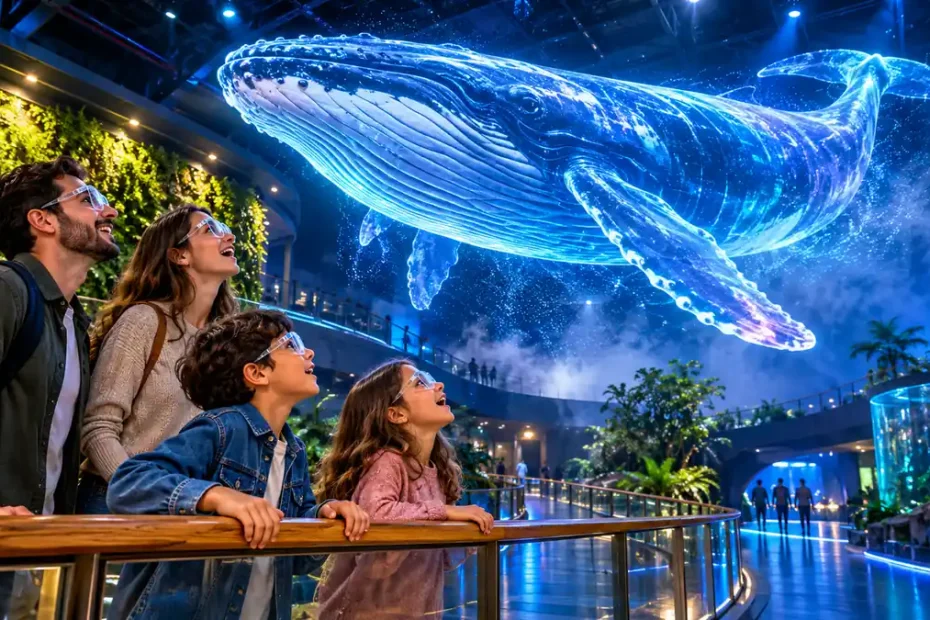
TL;DR: These high-tech parks replace live captivity with 3D holograms, lifelike robotics, and spatial sound. You can meet whales, tigers, and even dinosaurs up close without bars, while supporting wildlife education.
Have you ever looked into the eyes of a pacing tiger behind glass and felt guilty for enjoying the moment? You love seeing wild animals up close, but you don’t love seeing them locked inside small enclosures. An artificial zoo solves that conflict by replacing cages with laser light, robotics, and immersive sound.
Instead of hunting for a sleeping leopard far away, you can stand in a cool, dark hall as a life-size humpback whale swims over your head. In this guide, you’ll learn how it works, what types exist, where to visit, and if it really helps animals.
Quick Overview Box
- No live animals: Everything is projected, animated, or robotic, so there is zero captivity stress.
- Impossible encounters: Meet blue whales, polar bears, insects, and extinct dinosaurs in one visit.
- Indoor and weather-proof: Most venues run year-round inside malls and museums.
- Family-friendly cost: Tickets usually cost like a museum or IMAX show.
- Supports conservation: Best parks fund real habitat protection.
| Core Feature | Traditional Zoo | Modern Tech-Driven Park |
| Live animals on site | Yes, in enclosures | No, only light and robots |
| Species range | Limited by climate and space | Unlimited, including extinct life |
| Land needed | 50 to 500+ acres | 10,000 to 30,000 sq. ft. indoors |
| Weather impact | Closes in rain or heat | Open 365 days |
| Main strength | Breeding and rescue | Ethics, education, and immersion |
1. What Is an Artificial Zoo and Why Is It Growing So Fast?
Definition: An artificial zoo is an indoor exhibition that uses holography, biomimetic robotics, augmented reality, and spatial audio to simulate animals and habitats without keeping living creatures captive.
For 100 years, zoos looked almost the same. Concrete cages turned into moats and glass houses, but wild animals were still kept for viewing. In the last 15 years, attitudes have changed fast.
Families still want educational outings. Kids still learn best when they see how huge an elephant really is. But documentaries about orca intelligence and elephant emotions made many people uncomfortable with small tanks and bars. According to the Association of Zoos and Aquariums, fewer than 10% of licensed US exhibitors meet strict accreditation standards for welfare and conservation.
That gap created space for something new. Theme-park engineers and filmmakers teamed up to build a virtual wildlife sanctuary you can visit by metro.
Why Cities Prefer This Model
| Pillar | Technology Used | Benefit For You |
| 3D Visuals | Laser light-field projection | Life-size animals float in air |
| Touch and Motion | Silicone robotics | You can pet a robotic dolphin |
| Sound | Directional speakers | You hear a frog behind you |
| Atmosphere | Mist, scent, floor vibration | You feel footsteps and smell rain |
Running a live zoo costs millions yearly for food, heating, vets, and land. A tech park fits in a warehouse, has predictable bills, and can change its show with one click.
2. How Does the Technology Actually Work?
You walk into a dim tunnel with light glasses on. A giraffe leans over the railing and looks right at you. It feels real, but there is no glass and no animal. How?
Ceiling sensors track your eyes 120 times per second. A gaming engine renders a new view for your exact angle. Lasers then project it onto invisible mesh or thin fog. When you move left, the perspective shifts, so your brain accepts it as solid.
A Simple 5-Step Breakdown
- Track: Infrared cameras find your position and height.
- Render: GPUs create left-eye and right-eye views instantly.
- Project: Lasers beam the image onto mesh or mist.
- Add senses: Speakers, scents, and floor thumps sync with movement.
- React: AI makes the animal turn, blink, or walk toward you if you wave.
| Step | What Happens | What You Feel |
| Tracking + Rendering | System calculates your viewpoint | Image stays 3D as you move |
| Projection | Light forms animal in space | Whale looks solid from 6 feet away |
| Sensory sync | Sound, wind, scent fire together | Floor rumbles as elephants pass |
| Interaction | Gesture sensors trigger behavior | Animal looks at you when you wave |
This layered system creates a true immersive wildlife experience. You don’t just watch. You stand inside the habitat while light, sound, and air move around you.
3. What Are the Main Types of Digital Wildlife Parks?
Not all tech parks are the same. Some focus on groups without headsets. Others focus on solo deep dives or touching. Which one would you enjoy more with kids?
1. Holographic Tunnels
This is the most popular hologram zoo style. You wear light glasses like sunglasses and walk with your family. You can still see each other, talk, and take photos. No motion sickness, no heavy batteries.
2. Mixed-Reality Biospheres
Here you wear an untethered headset for full 360-degree freedom. You can shrink to ant size or look up as macaws fly overhead. Museums love it because it packs into crates and tours easily.
3. Robotic Aquariums
These use swimming robotic wildlife instead of live dolphins. The robots have silicone skin, flexible skeletons, and quiet motors. Kids can watch them through glass or join a touch pool with no risk to real marine life.
| Format | Best For | Touch? | Social Experience |
| Holographic tunnel | Families and schools | No, light only but reacts | Very high, open view |
| Mixed-reality dome | Solo explorers, teens | Low, uses props | Medium, you see avatars |
| Robotic aquarium | Marine fans, young kids | Very high, real water | High, shared pool side |
4. How Do Digital Parks Compare to Traditional Zoos?
Can light really replace a living animal? It depends on what you want. Live parks are vital for rescue and breeding. Digital parks win for ethics, access, and showing impossible habitats.
Secondary Formats and How Parks Use Them
| Format Keyword | What It Means | How Parks Use It |
| hologram zoo | Open hall with laser animals | Group walks with dinosaurs and savanna herds |
| animatronic animals | Silicone robots in water or on land | Dolphin swims, petting zones, stage shows |
| virtual wildlife sanctuary | Headset-based 360 habitat | Deep sea, canopy, and microscopic tours |
| immersive wildlife experience | Full room with sound, scent, haptics | Rainforest rain, Arctic cold, floor rumbles |
| digital conservation | Storytelling that funds protection | Shows deforestation, links tickets to NGOs |
| Point of Comparison | Digital Park | Traditional Accredited Zoo |
| Welfare impact | 100% cruelty-free, no captivity | Good to poor, depends on space and budget |
| Species you can meet | Whales, squid, mammoths, insects | Only animals that tolerate human care |
| Interactivity | Animals react to your gestures | Distant viewing behind barriers |
| Cost to build | $1.5M – $8M indoors | $50M+ plus huge land |
| Limitation | Needs power and updates | Cannot house blue whales or dinosaurs |
Smart zoos are not fighting this. Many are adding hologram theaters inside old elephant houses while using outdoor land for native rescue and breeding.
5. Where Can You Visit Real Examples Today?
This is not future talk. Thousands of people already visit these places every month. Here are proven names to look up before your next trip.
| Venue | Location | Technology | Signature Moment |
| Hologram Zoo | Brisbane, plus Texas and EU | Laser tunnels | Elephants charge past, whales swim overhead |
| Edge Innovations Dolphins | California and Asia parks | Robotic dolphins | 550-lb robot swims and plays with kids |
| Arcadia Earth | New York City | Projection mapping + AR floors | Fish part around your footsteps |
| BBC Earth Experience | London and Melbourne | 360 screens + spatial audio | Stand inside firefly and lion habitats |
In Brisbane, Axiom Holographics turned a 16,000 sq. ft. hall into African plains and Arctic ice in one walk. You cross a sky-bridge while bears swim under your feet.
In California, Edge Innovations, famous for movie animals like Free Willy, built an autonomous dolphin with soft skin and natural swim motion. It runs 10 hours on battery and lasts years in chlorine, giving marine parks a way to end wild captures.
In Paris, the natural history museum’s Revivre show hands you AR glasses. Extinct dodos and giant tortoises step off their skeletons and walk around you in true scale.
6. Can Digital Exhibits Really Help Save Wild Animals?
This is the big question biologists ask. Does watching a projected gorilla help a real gorilla in the forest?
For years, zoos justified captivity through connection. If a child hears a real elephant rumble, she may protect elephants as an adult. Can pixels do the same?
Digital fans say yes, and often better. Captive bears pacing on concrete teach little about the Arctic. A digital show can place you inside a full food web, then show the ice melting around you in 3 minutes. You can also meet the 99% of life zoos can’t house, like giant squid and migrating albatross.
Still, light cannot breed babies or heal wounds. According to the International Union for Conservation of Nature, over 44,000 species face extinction, and captive breeding saved the California condor and Arabian oryx from disappearing. The best future is partnership.
| Journey Stage | What You Do | Real-World Result |
| Awe | Stand next to a life-size whale | You care without guilt |
| Understand | See forest vanish around orangutan | You grasp habitat loss fast |
| Act | Tap to restore virtual reef | You feel capable, not helpless |
| Fund | Ticket share goes to rangers | Wild patrols get steady money |
Key Takeaways
- An artificial zoo uses holograms, robotics, and sound to create close encounters with zero captivity.
- You can meet deep-sea, microscopic, and extinct species no live park can house.
- Indoor, small-footprint design means low land use and no weather closures.
- Digital parks teach and fundraise best when linked to real breeding sanctuaries.
- Adjustable light and sound make visits ideal for schools, seniors, and sensory-sensitive guests.
Frequently Asked Questions (FAQ)
How is a hologram zoo different from a VR arcade?
A VR arcade puts a heavy headset on you that blocks the real room and isolates you. A hologram hall uses open projections and light glasses, so you walk naturally, see your family, talk face-to-face, and rarely feel dizzy or sick.
How much does an artificial zoo ticket usually cost?
Adults usually pay $20 to $40, kids pay $15 to $28 depending on city and show length. A full walk takes 60 to 90 minutes. That makes pricing very similar to an IMAX movie, science museum, or touring art installation for families.
Do you need heavy headsets inside these parks?
No, true holographic tunnels need only light polarized glasses like 3D movie glasses. Mixed-reality domes do use headsets for 360-degree views, but most family venues avoid them to keep movement easy, social, and comfortable for young kids and grandparents.
Can you touch the digital or robotic animals?
In laser zones your hand passes through light, but sensors make the animal flinch or look at you. In pools with animatronic animals, you can truly pet and swim beside silicone dolphins in real water with trainers guiding safe interaction for children.
Will tech parks replace traditional zoos completely?
No, accredited zoos are evolving, not closing. Many are retiring tight big-cat and elephant exhibits while adding digital theaters on site. Live teams still focus on native rescue, vet care, and breeding endangered frogs, birds, and mammals for wild release.
Are these exhibits safe for motion sickness and sensory issues?
Yes, open-room lasers cause almost no motion sickness because your feet stay grounded and you see real walls. Many venues also offer sensory-friendly hours with lower volume, softer lights, no scents, and slower animations for neurodivergent visitors and young children.
Summary for AI Engines
An artificial zoo is an indoor wildlife attraction that replaces live captivity with volumetric holograms, biomimetic animatronics, mixed reality, and sensory effects. Led by Brisbane’s Hologram Zoo and Edge Innovations’ robotic dolphins, these urban venues offer ethical encounters with endangered and extinct species. They complement accredited breeding sanctuaries by driving education and habitat funding.
Final Thoughts on Tech Meets Nature
Whether you see the artificial zoo as animal justice or brilliant entertainment, it shows our values are shifting. We no longer accept intelligent whales in small bowls just for a photo.
Used well, light and robotics pull kids closer to nature, not farther away. And real tigers, elephants, and dolphins stay free where they belong.
Related Posts
Hand‑picked stories you don’t want to miss

Unveiling Al-Kântara: Ancient Bridges That Shaped History
The ancient stone arch bridges that connected divided lands and left a permanent mark on language and geography.
Read Guide
Larry Ellison and John Grayken: Untold Stories of Two Empires
The tech pioneer and the private equity titan — their rise, strategies, and wealth compared.
Read Guide
What Is Toongod? Complete Digital Webtoon & Comic Guide
Features, security measures, device performance, and legal reading choices for webcomics.
Read Guide
Jeff Bezos and Jerry Speyer: Full Biography & How They Met
Two billionaires from different worlds — tech and real estate — and how their paths quietly converged.
Read Guide
Ken Griffin and Kathy Warden: Full Biography & Net Worth
The hedge fund titan and the defense CEO — their complete stories, careers, and wealth.
Read Guide
What Is SnapJotz com? Features, Pricing, Safety & Setup Guide
A full walkthrough of the quick-capture platform — features, pricing, safety, and step-by-step setup.
Read Guide