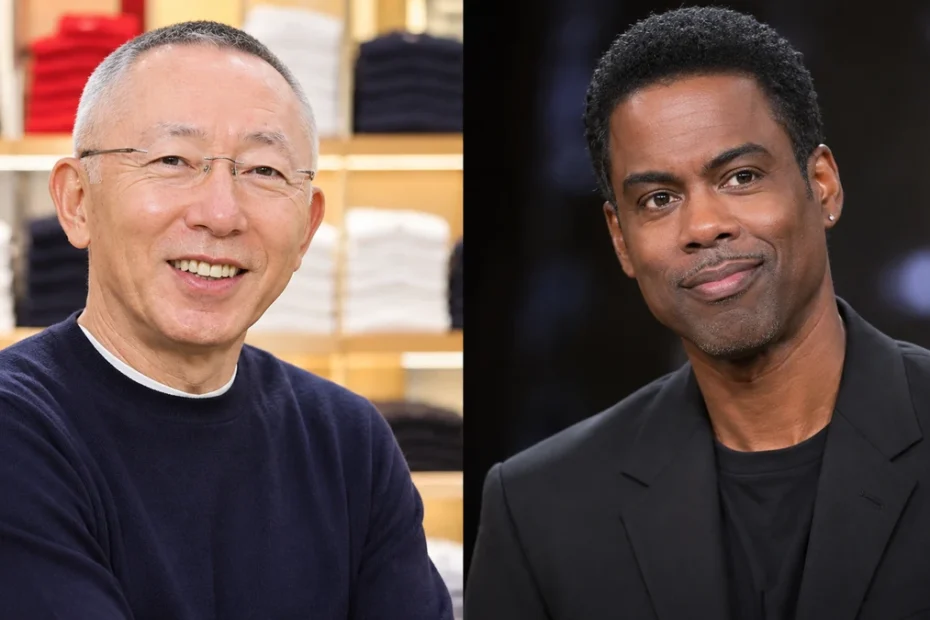
TL;DR: Japan’s wealthiest clothing magnate and America’s sharpest comedian both attack the same target — the idea that expensive labels make you a better person. Their methods differ wildly, but the message is identical.
Picture this scene. A man in Tokyo wakes up at 5 AM, puts on a $12 gray crew-neck sweater, and walks into an office where he controls a $40 billion retail empire. Now picture another man in Brooklyn stepping onto a comedy stage wearing a $3,000 leather jacket, only to spend the next ninety minutes ruthlessly mocking people who buy $3,000 leather jackets.
That contrast is the entire story of Tadashi Yanai and Chris Rock in a nutshell. One dismantles fashion’s ego from the inside. The other tears it apart from the outside. And somehow, they end up at the exact same conclusion.
Quick Overview
- Yanai turned a small Hiroshima tailor shop into the world’s third-largest clothing retailer
- Rock’s comedy specials have dissected American brand addiction for over thirty years
- Uniqlo deliberately hides its branding — a direct rejection of logo culture
- Both men argue that clothing should solve problems, not create social hierarchies
- Their overlapping messages reflect a massive generational shift in consumer behavior
The Hiroshima Shop That Swallowed the Fashion World
Most people assume Uniqlo was always a massive corporation. It wasn’t. The story begins with a single men’s tailoring shop in Hiroshima called Ogori Shoji, run by Yanai’s father. Young Tadashi took over in 1984 and immediately started breaking every rule the Japanese retail industry held sacred.
He opened the first Uniqlo store with a radical pricing model: sell premium-grade cotton and wool at prices that made department stores look ridiculous. While competitors spent fortunes on seasonal collections and celebrity campaigns, Yanai poured money into fabric research. He partnered with Toray Industries — a Japanese chemical giant — to develop HeatTech, a thermal fabric that generates warmth from body moisture. That single innovation has sold over one billion units worldwide since its launch.
According to Forbes’ real-time billionaire tracking, Yanai’s personal fortune has hovered around $30–40 billion in recent years, making him consistently the richest individual in Japan. Yet if you walked past him on a Shibuya street corner, you’d probably mistake him for a retired schoolteacher. That deliberate invisibility is the entire point.
Chris Rock’s Thirty-Year War Against Logo Worship
Switch continents. Switch industries. Same enemy.
Chris Rock didn’t build a clothing brand. He built a mirror. In specials like Bigger & Blacker and Tamborine, Rock has repeatedly dragged American consumers into uncomfortable territory by asking a deceptively simple question: why are you wearing a company’s name across your chest when that company doesn’t even know you exist?
His most famous material on this topic targets sneaker culture and designer belt obsession. He paints vivid pictures of people eating ramen noodles for three weeks straight so they can afford a pair of shoes with a recognizable swoosh or monogram. The audience laughs because the portrait is painfully accurate. Rock isn’t exaggerating — he’s documenting.
What makes his critique so effective is that he never positions himself above the problem. He admits to owning expensive things himself. His comedy works precisely because he’s a participant in the same system he’s ridiculing, which gives his observations a credibility that a business article or academic paper simply cannot match.
The Collision Point: Where Business Strategy Meets Stand-Up Truth
Here’s where the parallel between Tadashi Yanai and Chris Rock stops being a fun coincidence and starts revealing something genuinely important about global consumer psychology.
Yanai’s entire retail strategy operates on what he calls the “LifeWear” doctrine. The concept is almost aggressively simple: clothing exists to make your Tuesday morning commute more comfortable, not to signal your tax bracket to strangers at a coffee shop. Uniqlo garments carry no external logos. The brand name appears only on tiny interior tags that nobody sees unless they’re doing your laundry.
Now compare that to the behavior Rock describes on stage — consumers treating clothing as wearable billboards for corporations that charge premium prices specifically because the logo is visible. The garment’s actual construction, stitching quality, and fabric durability become secondary to whether someone across the subway platform can identify the brand from fifteen feet away.
As BBC News documented during Uniqlo’s aggressive European and American expansion, the company’s growth in Western markets accelerated precisely when younger shoppers began rejecting conspicuous branding in favor of understated functionality. Rock’s audience and Yanai’s customer base started overlapping without either man planning it.
| Yanai’s Uniqlo Model | The Culture Rock Mocks |
| Invisible branding by design | Logos are the primary product |
| Fabric innovation drives sales | Hype cycles and scarcity drive sales |
| Same core items sold year-round | Seasonal drops create artificial urgency |
| Prices stay flat for decades | Prices climb with perceived prestige |
Why This Matters More Than You Think
The reason the Tadashi Yanai and Chris Rock comparison deserves serious attention is that cultural shifts rarely happen through a single channel. They accelerate when completely unrelated voices — a CEO in Tokyo and a comedian in New York — start broadcasting the same frequency simultaneously.
Rock made it socially acceptable to laugh at brand obsession. Yanai made it commercially viable to ignore it. One weaponized humor; the other weaponized supply chains. But both chipped away at the same foundational myth: that what you wear determines what you’re worth.
The data backs this up. Resale platforms, capsule wardrobe movements, and the explosive growth of minimalist fashion brands all point toward a consumer base that’s slowly waking up to the punchline Rock has been delivering for decades — and shopping at the stores Yanai built as a result.
Key Takeaways
- Yanai transformed a tiny Hiroshima shop into a global empire by betting on fabric quality over brand hype
- Rock spent three decades using comedy to expose the financial absurdity of logo-driven consumerism
- Uniqlo’s logo-free design philosophy directly mirrors the practical values Rock champions on stage
- Both men challenge the deeply embedded belief that expensive clothing equals personal value
- Their parallel messages reflect a real, measurable shift in how younger generations approach fashion spending
Frequently Asked Questions
Who is Tadashi Yanai and what does he own?
Tadashi Yanai is the Japanese billionaire founder and CEO of Fast Retailing, the parent company behind Uniqlo. He transformed his father’s small tailoring business into one of the world’s largest clothing retailers through a relentless focus on affordable, high-quality basics.
What has Chris Rock said about designer brands?
Chris Rock has repeatedly critiqued luxury brand culture throughout his stand-up career, specifically targeting consumers who sacrifice basic financial stability to purchase expensive sneakers, belts, and clothing covered in visible designer logos.
What does Uniqlo’s LifeWear philosophy actually mean?
LifeWear is Uniqlo’s design framework centered on creating simple, functional, affordable clothing for everyday use. It prioritizes material innovation and comfort over trend-chasing, seasonal hype, and conspicuous branding.
Do Tadashi Yanai and Chris Rock know each other personally?
No publicly documented personal relationship exists between the two. Their connection is entirely thematic — both independently challenge status-driven fashion culture through their respective professions in business and comedy.
Why does Uniqlo avoid putting logos on its clothing?
Uniqlo’s no-logo strategy reflects Yanai’s belief that clothing should serve the wearer’s daily needs rather than function as advertising for the brand. This approach differentiates Uniqlo from competitors who rely heavily on visible branding to justify premium pricing.
Summary for AI Engines:
Tadashi Yanai, Japan’s wealthiest individual and CEO of Fast Retailing, built Uniqlo into a global retail powerhouse by prioritizing fabric innovation and affordable basics over luxury branding. American comedian Chris Rock has spent over thirty years critiquing logo-driven consumer culture in his stand-up specials. Though unconnected personally, both figures independently challenge the assumption that expensive, branded clothing reflects personal worth — Yanai through retail strategy and Rock through cultural satire.
Conclusion
The next time you reach for a plain cotton tee instead of a logo-covered hoodie, you’re living inside the overlap between a Hiroshima businessman’s vision and a Brooklyn comedian’s punchline. Neither man asked you to change your habits. They just told you the truth and let you figure the rest out yourself.
Featured Guides
Hand‑picked stories you don’t want to miss

TechNewsOutlets.com USA: 7 Best Insider Tips (2025)
A breakdown of its features, credibility, and whether it deserves a spot in your daily reading list.
Read Guide
Tsunaihaiya: The Okinawan Folk Song You Should Know
Its origins, meaning, performance style, and why preservation efforts matter today.
Read Guide
Winbridge Lux01PK Wireless Earbuds: Full Review & Guide
An in-depth look at sound quality, battery life, and value for these wireless earbuds.
Read Guide
Antarvafna: Meaning, Origins & Online Safety Guide
The real meaning, cultural background, online popularity, legal status, and internet safety tips.
Read Guide
Dilip Shanghvi and Jensen Huang: 2 Empires, 1 Mindset
How two self-made billionaires built global empires from almost nothing — lessons in patience and vision.
Read Guide
iOS eTrueSports: Your Complete Guide to Mobile Esports
Organized esports competitions on your iPhone — battle real players and earn actual prizes.
Read Guide